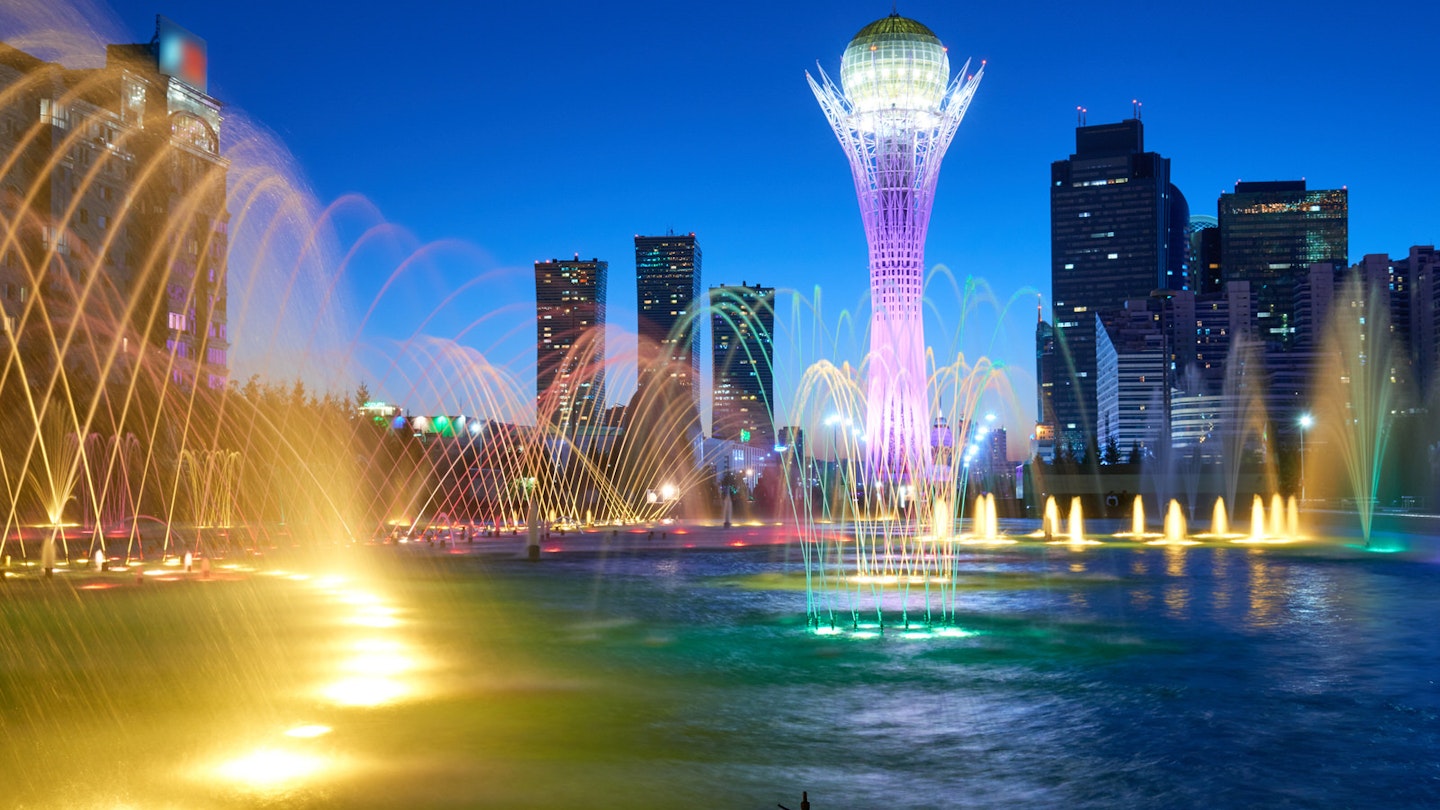
Like any capital city worth its salt, Astana’s dining scene is varied and expanding fast. Culinary offerings range from comfort Kazakh food at the likes of Epoch (a kitschy Soviet restaurant at 9 Valikhanov St) and Vechnoye Nebo (vechnoenebo.kz) to excellent shashlik (skewered meat) and own brew at the Line Brew microbrewery. International cuisines are also well represented: authentic Indian at Fusion Guru (thefusionguru.com), excellent sushi at Izumi Tay (facebook.com/izumi.astana), spicy Korean at Korean House (korean-house.kz) and fragrant Georgian at Daredzhani (Qabanbay Batyr Ave 34).
The 150m-high, translucent Khan Shatyr is one of Astana’s most remarkable buildings. Designed by Norman Foster, it’s the largest marquee in the world. The structure is made of ethylene tetrafluoroethylene, a heat-absorbing material that keeps the temperature inside the marquee-cum-shopping-centre a balmy 20+ degrees, a tropical oasis in the depths of winter. In addition to shops spread across multiple floors, the Khan Shatyr features a monorail and rides for kids. The top floor has been turned into the exclusive Sky Beach Club, which has a sandy beach, swimming pool, palm trees, water slides, and more – particularly nice when winter temperatures plunge into the negatives.
The area around Astana has a sombre history. During Stalin’s reign, the village of Malinovka, 35km west of Astana, was home to ALZhIR, an internment camp for the wives and children of the ‘enemies of the people’. The Museum-Memorial Complex honours the victims of Soviet political repression with numerous displays on the Gulag system in Kazakhstan. Tour companies in Astana can arrange day tours. In Astana itself, you can spot wonderful Soviet-era mosaics of the working class on the old train station building. Several blocks from the old train station, you can see a decrepit grain silo, dating back to the ill-fated Virgin Lands project pushed by Nikita Khrushchev in the 1950s.